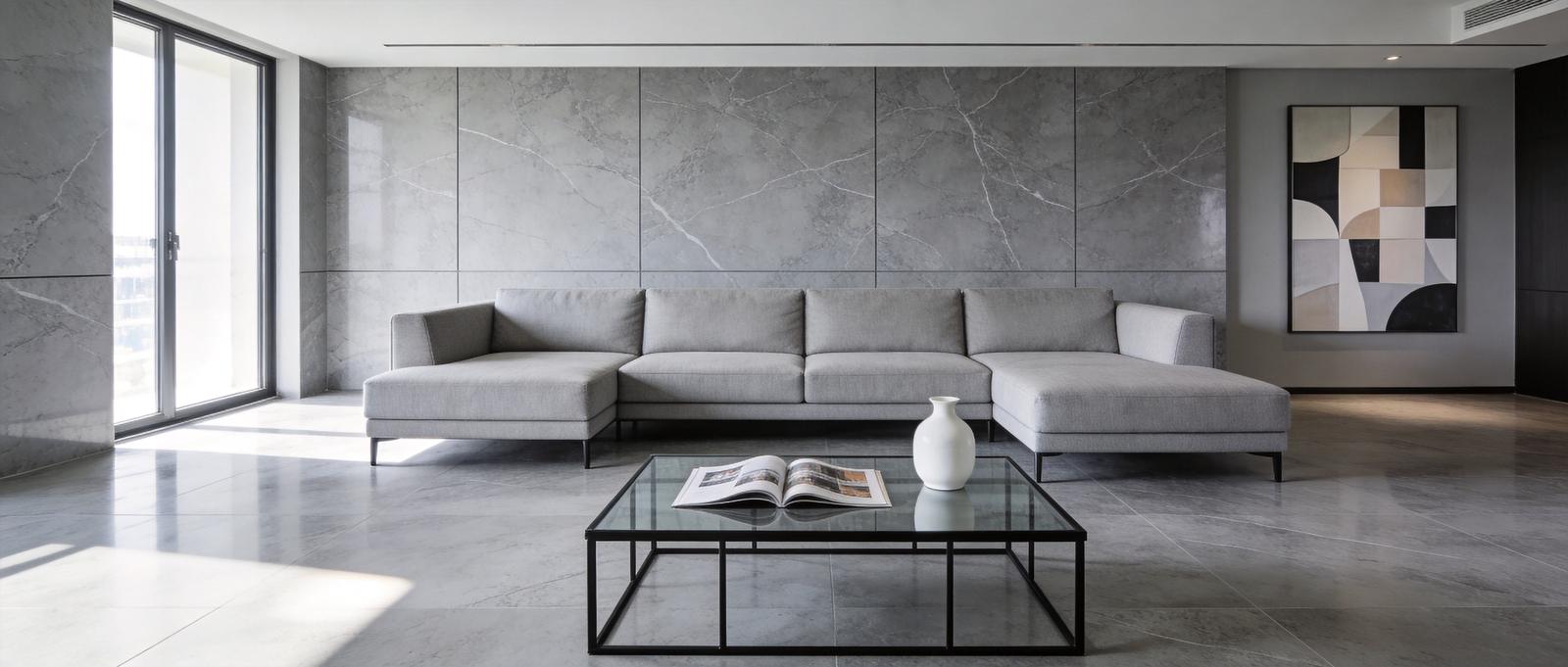
Sintered Stone vs Granite: An Architectural Comparison
When specifying premium surface materials for architectural projects, architects and designers frequently compare sintered stone vs granite as two leading options. Both materials offer natural beauty, exceptional durability, and established track records in demanding applications. However, their fundamental differences—in origin, composition, maintenance requirements, and design flexibility—make each more suitable for specific project contexts.
This comprehensive comparison examines sintered stone and granite across the key dimensions that matter most to architectural professionals: durability, maintenance, aesthetics, sustainability, and total lifecycle cost.
Material Origins and Composition
Granite: Nature's Engineering
Granite is an igneous rock formed from slowly cooling magma deep within the Earth's crust, a process that spans millions of years. Its composition typically includes feldspar, quartz, mica, and various trace minerals. The specific mineral ratios and cooling conditions determine the stone's color, pattern, and physical properties. Each granite quarry produces material with inherent, unrepeatable variations—the signature of natural stone's geological authenticity.
The properties of granite vary considerably between quarry sources and even within a single quarry block. Architects specifying granite must work with these natural variations, which can affect color consistency across large projects. Some granite varieties may contain microfractures or mineral inclusions that affect performance in certain conditions.
Sintered Stone: Engineered Excellence
Sintered stone is manufactured from a precise blend of carefully selected natural minerals—feldspar, silica, quartz, and clay—that are compressed under extreme pressure and fired at temperatures exceeding 1,200°C. This controlled manufacturing process produces a dense, homogeneous material with consistent properties across every slab. There is no geological variation: every square meter of a given sintered stone product meets identical specifications.
The sintering process creates a crystalline structure with no interconnected porosity, no resin content, and no organic components. The result is a chemically inert, dimensionally stable material that performs consistently across all environmental conditions.
Durability and Performance
Hardness and Scratch Resistance
Granite achieves Mohs hardness ratings of 6 to 7, making it one of the hardest natural stones available for architectural use. This hardness provides good scratch resistance for daily use in kitchen and commercial applications.
Sintered stone matches or exceeds this hardness with Mohs ratings of 6 to 7, achieved through the controlled crystalline structure formed during sintering. The material's dense, homogeneous composition provides consistent scratch resistance throughout the entire slab thickness, rather than concentrated at the surface.
Porosity and Stain Resistance
Granite's porosity varies by variety, ranging from approximately 0.2% to 0.5% water absorption for most commercial granites. This porosity necessitates periodic sealing to maintain stain resistance. Without regular sealing, granite can absorb liquids that cause permanent staining—particularly from acidic substances like wine, citrus juice, and coffee.
Sintered stone's porosity is essentially zero—less than 0.1% water absorption. No sealing is required or beneficial. The material's crystalline structure is inherently resistant to staining from the full spectrum of household and commercial substances, including aggressive chemicals that would damage or etch natural stone.
Chemical and Acid Resistance
Granite is susceptible to etching from acidic substances. Even sealed granite can be affected by prolonged exposure to acidic foods, drinks, or cleaning products. The etching appears as dull spots on polished surfaces and can compromise the appearance of even well-maintained installations.
Sintered stone demonstrates excellent chemical resistance across the full pH range, from acidic to alkaline substances. This resistance makes it suitable for laboratory countertops, pharmaceutical applications, and food preparation surfaces where chemical exposure is expected.
Thermal Performance
Granite has good heat resistance and can typically withstand hot cookware without damage. However, thermal shock—rapid temperature changes—can cause cracking in some granite varieties, particularly those with internal stresses from the quarrying process.
Sintered stone has superior thermal shock resistance due to its homogeneous, stress-free crystalline structure. Hot pots and pans can be placed directly on sintered stone surfaces without concern for thermal damage. The material's low thermal expansion coefficient also ensures dimensional stability across temperature extremes.
Maintenance Requirements
Granite Care Protocol
Maintaining granite surfaces requires ongoing attention:
- Sealing: Initial sealing at installation, followed by annual reapplication
- pH-neutral cleaners: Acidic or abrasive cleaners damage the stone surface and degrade sealants
- Spill management: Immediate cleanup of acidic substances to prevent etching and staining
- Professional restoration: Periodic polishing to maintain surface appearance
- Specialized products: Stone-specific cleaning and maintenance products required
Sintered Stone Care Protocol
Sintered stone maintenance is straightforward:
- Regular cleaning: Warm water and a soft cloth for daily maintenance
- General cleaners: pH-neutral household cleaners for more thorough cleaning
- No sealing: Never required—sealers will not bond to sintered stone
- No special products: Standard cleaning supplies are fully effective
- Deep cleaning: Occasional cleaning with specialized stone cleaners if needed
This maintenance contrast represents one of the most significant practical advantages of sintered stone for both residential and commercial applications.
Aesthetic Considerations
Granite's Natural Beauty
Granite's aesthetic appeal lies in its geological authenticity. Each slab presents a unique mineral landscape—the result of millions of years of natural formation. For clients who value the irreproducible character of natural materials, granite's inherent variation can be a decisive factor. No two granite slabs are identical, creating genuinely unique installations.
Granite's color palette is determined by its mineral composition and quarry origin, resulting in characteristic colors and patterns specific to each geographic source. Brazilian granites tend toward dramatic colors and bold patterns, while Indian and African varieties offer diverse aesthetic options.
Sintered Stone's Design Range
Sintered stone's aesthetic capabilities extend far beyond natural stone imitation. Advanced manufacturing technologies enable:
- Marble effects: Hyper-realistic recreations of Calacatta, Statuario, Carrara, and rare marble varieties
- Consistent reproduction: Identical pattern matching across unlimited slab quantities for large projects
- Through-body aesthetics: Surface patterns extend through the full slab thickness for fabrication flexibility
- Contemporary designs: Solid colors, concrete effects, metallic finishes, and innovative textures
- Custom capabilities: Project-specific color matching available through select manufacturers
Format and Size
Standard granite slabs typically range from 1,000×2,000mm to 1,500×3,000mm. Larger formats are possible but become increasingly expensive and logistically challenging due to the physical properties of natural stone.
Sintered stone is manufactured in large formats up to 1,600×3,200mm and even larger specialty sizes. These expansive slabs minimize joints in wall and floor applications, creating seamless surfaces that are both aesthetically superior and more hygienic—fewer joints mean fewer places for dirt, bacteria, and moisture to accumulate.
Cost Comparison
Material Costs
Material costs for granite and sintered stone overlap significantly for standard grades. Entry-level granite varieties may be less expensive than premium sintered stone products, while exotic granite varieties—Blue Pearl, Labrador Antique, Patagonia, and similar premium materials—can exceed premium sintered stone pricing substantially.
Sintered stone from established manufacturers like MENGNA SURFACES offers competitive pricing across all standard format options, with volume pricing available for large projects.
Total Lifecycle Cost
When evaluating total lifecycle cost, sintered stone typically demonstrates superior value:
- No sealing costs: Eliminating annual sealing saves $2-5 per square foot annually
- No restoration: Granite may require professional restoration every 5-10 years
- No specialized cleaners: Standard products are fully effective for sintered stone
- Extended appearance life: Sintered stone maintains its original appearance indefinitely without intervention
Sustainability Considerations
Granite extraction involves quarrying operations with significant environmental footprints, including land disruption, energy consumption, and transportation of heavy material over long distances. However, granite's natural durability and extremely long service life—50+ years with proper maintenance—partially offset these initial impacts.
Sintered stone production uses natural raw materials with relatively lower environmental impact per unit than quarrying and processing natural stone. The material's durability and 50+ year service life contribute to favorable lifecycle environmental performance. Manufacturers increasingly incorporate recycled materials and optimized firing processes to reduce production energy consumption.
Application-Specific Recommendations
Where Granite Excels
Granite remains an excellent choice when:
- Clients specifically value natural stone authenticity and unique slab variation
- Traditional aesthetic language is preferred for heritage or period-sensitive projects
- Project specifications explicitly require natural stone materials
- Local quarry sources provide logistical advantages
Where Sintered Stone Excels
Sintered stone is the superior choice when:
- Low maintenance or maintenance-free surfaces are required
- Large-format seamless installations are specified
- Outdoor or UV-exposed applications are planned
- Chemical resistance or food-safety compliance is needed
- Color consistency across extensive areas is required
- Contemporary design aesthetics are preferred
Conclusion
The comparison between sintered stone vs granite ultimately reveals two excellent materials with distinct strengths. For architectural projects where maintenance, consistency, and design flexibility are priorities, sintered stone represents the more practical choice. For projects where natural material authenticity and unique geological character are paramount, granite remains a compelling option.
Explore how sintered stone can meet your project's specifications. Contact MENGNA SURFACES for samples, technical consultation, and project-specific guidance, or browse our complete product range to discover the available design options.