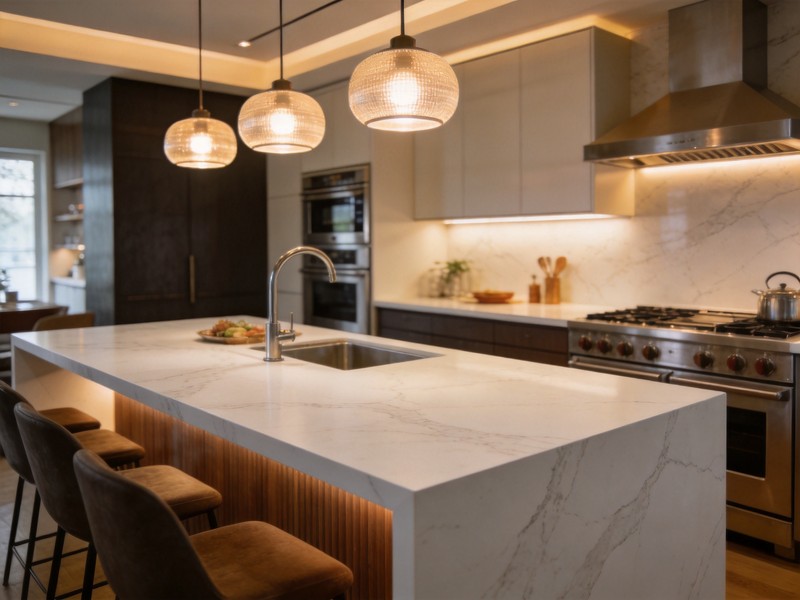
Why Sintered Stone Is the Premier Choice for Countertops
Sintered stone countertops have established themselves as the benchmark against which all other kitchen and bathroom surface materials are measured. For architects and designers specifying premium projects, understanding the full range of options, technical considerations, and design possibilities is essential to delivering exceptional results for clients.
The countertop surface is the functional heart of any kitchen or bathroom—a zone of constant use, temperature extremes, moisture exposure, and visual scrutiny. Selecting the right material for this demanding application requires balancing performance characteristics with aesthetic intent, and sintered stone delivers across every dimension.
Understanding Sintered Stone Countertop Specifications
Thickness Options and Performance
Sintered stone countertops are available in a range of thicknesses, each suited to different performance requirements and aesthetic goals:
- 12mm: The most popular choice for residential kitchen countertops. When mounted on a proper plywood or MDF substrate, 12mm panels provide excellent rigidity and load-bearing capacity at a competitive price point. Ideal for standard residential applications where budget optimization is desired.
- 15mm: Appropriate for heavy-use residential kitchens and light commercial applications. Provides enhanced impact resistance and can be mounted with minimal substrate support in many configurations.
- 20mm: The commercial standard for demanding environments including restaurants, hotels, and food service facilities. Provides maximum rigidity, impact resistance, and durability for high-traffic applications.
Thickness selection should consider not only the load requirements but also the edge treatment planned—mitered edges can create the appearance of thicker material from thinner slabs, allowing cost optimization while achieving premium aesthetics.
Format and Slab Dimensions
Large-format sintered stone slabs—available in dimensions up to 1,600×3,200mm from manufacturers like MENGNA SURFACES—offer significant advantages for countertop applications. Larger slabs mean fewer joints across extensive countertop runs, creating cleaner visual lines and reducing potential moisture ingress points. For island countertops and peninsula installations, a single slab may cover the entire surface with no visible seams.
Surface Finishes for Countertops
Polished Finish
The high-gloss polished finish is the classic choice for sintered stone countertops. Polishing creates a mirror-like surface that enhances color depth and pattern clarity—particularly effective for marble-effect designs where the characteristic veining is most dramatically displayed. Polished surfaces are also the easiest to clean, as their smooth texture resists particle adhesion and allows effortless wiping.
Honed Finish
The honed finish achieves a satin-smooth surface with reduced reflectivity. This softer appearance suits contemporary design schemes where the understated elegance of matte surfaces is preferred. Honed sintered stone countertops offer the same durability and stain resistance as polished variants but with a distinctly different aesthetic character.
Matte and Textured Finishes
Matte and lightly textured finishes are increasingly popular for contemporary kitchen designs. These surfaces add tactile dimension and can help mask minor scratches or wear marks that might be visible on high-gloss surfaces. Some textured finishes also provide practical benefits: they can reduce the visibility of fingerprints and water spots on dark-colored surfaces.
Edge Profile Options
Standard Edge Profiles
Sintered stone can be fabricated with virtually any edge profile that traditional stone materials accept:
- Straight (Square) Edge: Clean, contemporary, and modern. The crisp vertical face creates a sharp geometric line that works well with minimalist design schemes.
- Eased Edge: A slightly softened square edge with minimal radius. Maintains the contemporary aesthetic while reducing the sharpness of true square edges.
- Beveled Edge: A diagonal cut along the top edge creates visual interest and softens the overall appearance. Popular in transitional design contexts.
- Bullnose: A fully rounded edge profile—classic, safe, and timeless. Particularly appropriate for residential applications where children may be present.
- Half-Bullnose: A partially rounded profile combining visual softness with practical durability.
- Ogee Edge: A more traditional, ornate profile with a curved S-shape. Often specified for classical or transitional kitchen designs.
Waterfall and Full-Vein Edges
Contemporary design has popularized the waterfall edge treatment, where the countertop surface continues vertically down the cabinet face, creating a continuous surface appearance. Sintered stone's through-body color and pattern make it ideal for this application—the vertical surface presents the same visual character as the horizontal surface, creating a cohesive, designed element rather than a utilitarian edge treatment.
Mitered Edges
Mitered edge construction joins two pieces of thin sintered stone at a 45-degree angle, creating the appearance of a much thicker slab edge. This technique allows designers to achieve substantial-looking countertop edges from cost-effective thin panels (12mm), while maintaining the full visual depth of premium thick-material aesthetics. It is a particularly effective technique for large kitchen islands where visual impact matters.
Performance in Kitchen Environments
Heat Resistance
Sintered stone countertops demonstrate exceptional thermal performance, with heat resistance exceeding 900°C. This far exceeds the temperature of any cookware used in domestic or commercial kitchens. Hot pots, pans, baking trays, and roasting dishes can be placed directly on sintered stone surfaces without the risk of scorching, blistering, or discoloration that affects quartz and solid surface materials.
This thermal tolerance also provides practical benefits during cooking: hot items can be placed anywhere on the surface rather than requiring trivets or hot pads, reducing the visual clutter of kitchen accessories and enabling cleaner design expressions.
Scratch and Impact Resistance
With Mohs hardness of 6-7, sintered stone resists scratching from knives, cookware, and kitchen tools. While cutting directly on the surface is not recommended (as it will eventually dull knives), the material withstands the incidental contact and sliding of kitchen items without visible surface damage.
Impact resistance is similarly strong, though as with all rigid materials, a sufficiently forceful impact at a vulnerable point (near an unsupported edge or corner) can cause chipping. Proper fabrication and installation—including adequate edge support and appropriate corner radii—minimize this risk significantly.
Stain Resistance and Hygiene
The near-zero porosity of sintered stone eliminates concerns about staining from the full range of kitchen substances—wine, coffee, olive oil, tomato sauce, turmeric, and acidic foods that would permanently stain natural stone. Spills can be wiped away without urgency, and even dried-on substances release easily with standard cleaning.
This non-porous quality also means sintered stone countertops do not harbor bacteria, mold, or mildew in the surface structure. For food preparation areas and healthcare-adjacent applications, this inherent hygiene advantage is increasingly valued.
Installation Best Practices
Substrate Requirements
Proper structural support is essential for sintered stone countertop performance. Standard installation practice involves mounting the sintered stone panel over a rigid substrate—typically 18mm plywood or high-density MDF—bonded to the cabinet structure. This composite construction provides the necessary rigidity for thin-format sintered stone while maximizing material efficiency.
Joint Placement and Design
Where countertop joints are unavoidable—across long runs, around sinks, or at corner transitions—they should be designed as deliberate elements rather than afterthoughts. Joint placement should consider:
- Visual flow: Position joints where they are least conspicuous
- Structural integrity: Ensure adequate support on both sides of the joint
- Silicone selection: Use flexible, color-matched silicone sealant designed for stone applications
- Expansion accommodation: Allow for thermal expansion in longer installations
Sink Integration
Sintered stone countertops accommodate various sink integration methods:
- Undermount sinks: The most popular option, creating a clean transition from countertop to sink basin
- Flush-mount sinks: The sink rim sits flush with the countertop surface for a completely seamless appearance
- Integrated drainboards: Some sintered stone designs incorporate molded drainboard channels
Design Applications Beyond Kitchens
While kitchens represent the primary countertop application, sintered stone's performance characteristics make it equally suitable for:
- Bathroom vanities: Moisture resistance and hygiene make sintered stone ideal for bathroom environments
- Bar tops and dining surfaces: Heat resistance and stain resistance suit hospitality applications
- Commercial food prep areas: NSF certification for food contact available with specific products
- Laboratory countertops: Chemical resistance exceeds requirements for most laboratory environments
Conclusion
Sintered stone countertops represent the current pinnacle of engineered surface technology—offering architects and designers a material that performs flawlessly in demanding kitchen environments while delivering the aesthetic range that contemporary design requires. From the practical considerations of heat resistance and maintenance to the design opportunities of large formats and waterfall edges, sintered stone delivers on every promise.
Ready to specify sintered stone countertops for your next project? Contact MENGNA SURFACES for technical specifications, edge profile consultation, and sample requests, or explore our full countertop collection.