
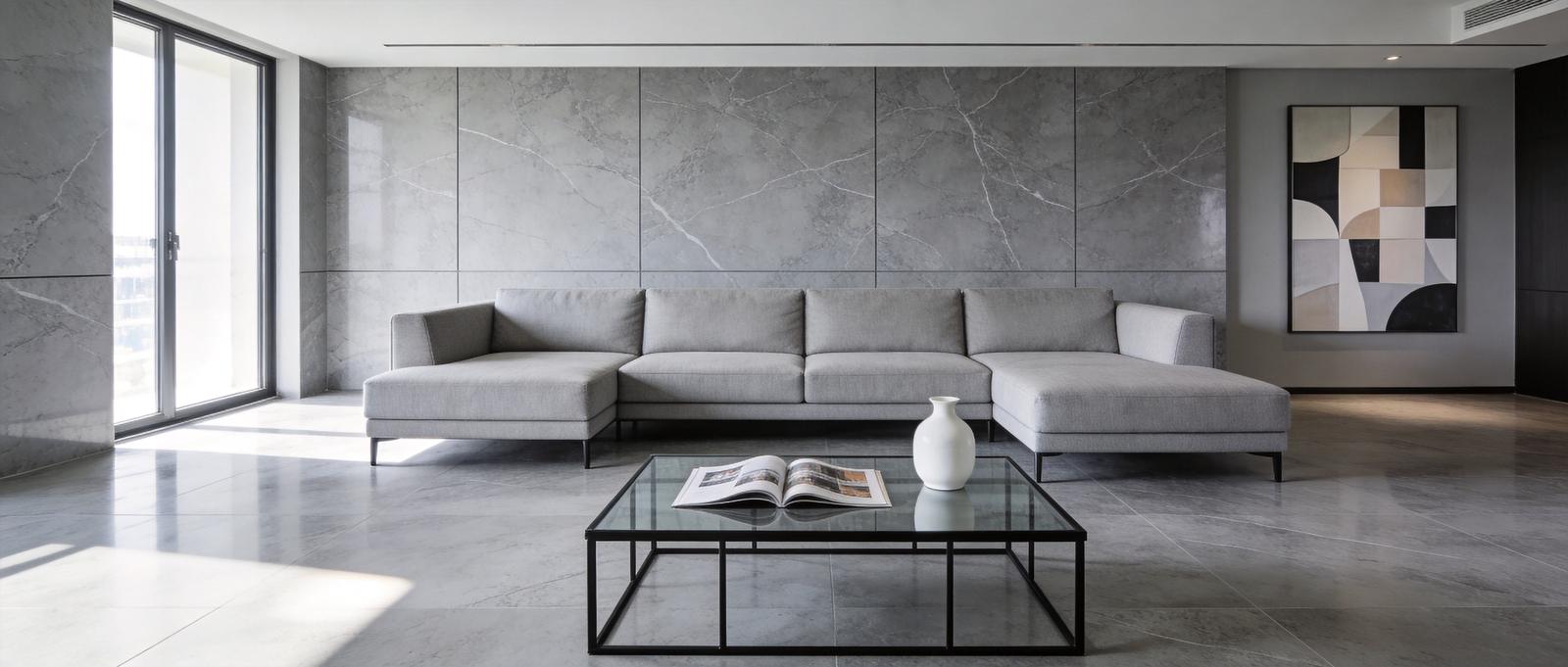
Choosing between sintered stone vs ceramic tiles requires understanding materials that appear similar but differ fundamentally. Both serve floors and walls, but their performance characteristics, aesthetic capabilities, and value propositions diverge significantly. This comparison guide helps architects, designers, and homeowners make informed decisions for their specific applications.
Understanding the Materials
What Are Ceramic Tiles?
Ceramic tiles encompass a broad category of clay-based products including traditional ceramics, quarry tiles, and porcelain. Manufacturing involves shaping clay mixtures, drying, and firing in kilns at temperatures typically ranging from 900°C to 1,200°C. Most ceramic tiles feature surface glazing that provides coloration and stain resistance, though some products offer through-body coloration. Standard formats range from small mosaics (25mm) to large format slabs (1200x2400mm in premium products).
What Is Sintered Stone?
Sintered stone represents a distinct category of engineered surface material. Rather than traditional clay compositions and standard firing, sintered stone compresses natural mineral compounds—feldspar, quartz, silica, and inorganic pigments—at pressures exceeding 15,000 tons and temperatures above 1,200°C. This process creates a completely vitrified, non-porous material with entirely different performance characteristics. The result is a surface material rather than a traditional tile—though it installs using similar methods.
Manufacturing Differences
The fundamental performance gap between these materials stems from their manufacturing processes:
Ceramic Tile Production
- Clay body formed through extrusion or pressing
- Dried to remove moisture
- Surface glaze applied (typically screen or digital printed)
- Kiln fired at 900-1,200°C
- Final sizing and sorting
Sintered Stone Production
- Precisely measured mineral compounds blended
- Compressed under 15,000+ tons pressure
- Sintered at 1,200°C+ in specialized kilns
- Surface treatments applied (polishing, texturing)
- Quality inspection and calibration
The extreme pressure and temperature of sintered stone production creates molecular fusion impossible in standard ceramic production. This explains the performance advantages explored below.
Physical Properties Comparison
Hardness and Scratch Resistance
Sintered stone achieves Mohs hardness ratings of 6-7, comparable to quartz and exceeding most natural stones. This hardness provides exceptional scratch resistance—knife marks, abrasive dirt, and heavy furniture cause no permanent damage. Standard ceramic tiles typically rate 5-6 on the Mohs scale; while adequate for most residential use, they scratch more readily from heavy objects, pet claws, or abrasive cleaning. Glazed ceramics may show scratches more visibly when the underlying ceramic shows through.
Water Absorption
Water absorption determines a material's suitability for wet applications:
- Sintered stone: Less than 0.1% absorption (effectively waterproof)
- Porcelain tiles: 0.5% or less (very low absorption)
- Standard ceramic: 3-10% absorption (higher porosity)
Low absorption proves critical for exterior applications, wet rooms, and any installation exposed to freeze-thaw cycles. Sintered stone's near-zero absorption handles conditions that cause cracking in standard ceramics.
Impact Resistance
Heavy object drops reveal significant differences. Sintered stone's monolithic construction provides uniform impact resistance; while the edge may chip from severe impact, the damage remains localized. Ceramic tiles may crack through the body or chip at edges. Glazed ceramics show damage more visibly when the different-colored body shows through the surface coating.
Aesthetic Capabilities
Design Range
Modern ceramic tile production offers impressive aesthetic variety:
- Digital printing creates realistic stone, wood, and concrete patterns
- Matte, glossy, and textured finishes available
- Consistent coloration within production runs
- Standard sizes from mosaics to large formats
Sintered stone expands these possibilities:
- Advanced printing achieves photorealistic natural stone reproduction
- Through-body or full-body coloration creates authentic material depth
- Larger formats (up to 1600x3200mm) enable seamless installations
- Bookmatched and continuous-pattern designs possible with large slabs
Surface Integrity
Ceramic tiles feature surface-applied designs—either glazed or digitally printed. Damage exposing the body reveals different coloration beneath the surface. Sintered stone's coloration extends throughout the material thickness (through-body or full-body). Any edge chipping or surface abrasion shows the same color and pattern, making damage virtually invisible. This characteristic proves especially valuable for commercial applications where appearance maintenance is essential.
Large Format Advantages
Sintered stone's manufacturing process enables true large format capabilities:
- Slabs up to 1600x3200mm available
- Thin formats (3-6mm) for wall cladding and overlay installations
- Consistent thickness tolerance across large sheets
- Minimized joints create cleaner aesthetics
Premium ceramics can achieve large formats, but standard products typically max out at 1200x1200mm. Ceramic large formats also require thicker gauges for structural integrity, limiting some applications.
Installation Considerations
Substrate Requirements
Both materials require proper substrate preparation:
- Ceramic tiles: standard thin-set over cement backer board or concrete
- Sintered stone: similar thin-set application but often requires larger notched trowels for proper coverage
Sintered stone's larger formats and reduced flexibility demand more precise substrate leveling. Floor flatness tolerances of 3mm over 3 meters are essential for successful large format installation.
Cutting and Fabrication
Ceramic tile cutting is relatively straightforward:
- Manual score-and-snap for straight cuts
- Wet saw for precise cuts and complex shapes
- Tile nipper for small notches and curves
Sintered stone requires more specialized equipment:
- Diamond blade wet saw or bridge saw for straight cuts
- Waterjet cutter for complex shapes and edge profiles
- CNC machining for precision fabrication
- Professional installation recommended for most applications
Adhesive and Grout
Both materials use similar adhesive systems, though sintered stone may require polymer-modified thin-set for demanding applications. Grout selection follows similar principles—epoxy grout offers best stain resistance for both materials, though sintered stone's non-porous surface makes grout maintenance less critical.
Application Suitability
Where Ceramic Tiles Excel
- Budget-conscious residential projects: Lower material cost provides good value for standard applications
- Utility spaces: Bathrooms, laundry rooms, and mudrooms where premium aesthetics are less critical
- Rental properties: Cost-effective for spaces where premium materials may not recoup investment
- Do-it-yourself installations: Easier cutting and handling enable homeowner installation
- Wall applications: Lighter weight and easier handling simplify vertical installations
Where Sintered Stone Excels
- Premium residential projects: Superior aesthetics justify higher investment
- Commercial flooring: Exceptional durability handles heavy traffic; low maintenance reduces operating costs
- Large format applications: Seams-averse designs benefit from minimal joint installations
- Exterior applications: Frost resistance and UV stability outperform ceramics
- Countertops and furniture: Ceramic cannot serve these applications; sintered stone excels
- Healthcare and hygiene environments: Completely non-porous surface prevents bacterial growth
Cost Analysis
Material Costs
Ceramic tile pricing spans wide ranges:
- Standard wall tiles: $3-10 per square foot
- Quality floor tiles: $8-20 per square foot
- Premium porcelain: $15-40 per square foot
Sintered stone pricing:
- Standard collections: $15-35 per square foot
- Premium large format: $25-60 per square foot
- Exotic patterns: $40-100+ per square foot
Installation Costs
Professional installation typically adds:
- Ceramic tiles: $8-15 per square foot depending on complexity
- Sintered stone: $15-30 per square foot due to specialized handling and cutting
Lifetime Cost Considerations
Lifetime cost analysis favors sintered stone for demanding applications:
- Sintered stone maintains appearance for 50+ years; may never require replacement
- Ceramic tiles typically last 20-30 years before replacement consideration
- Sintered stone never requires sealing; ceramic may need periodic resealing
- Repair visibility differs: ceramic chips show differently-colored body; sintered stone damage is less visible
Making Your Selection
Choose Ceramic Tiles When:
- Project budget prioritizes lower initial cost
- Application involves walls or light-duty surfaces
- DIY installation is planned
- Standard aesthetics are acceptable
- Installation timeline is compressed
Choose Sintered Stone When:
- Premium aesthetics and authenticity are priorities
- Application demands maximum durability
- Large format, minimal-seam installations are planned
- Countertop or furniture applications are involved
- Long-term value supersedes initial cost
- Exterior or demanding environmental conditions apply
At MENGNA SURFACES, we recognize that both materials have their place. Our team helps clients select the appropriate material based on application requirements, aesthetic goals, and budget constraints—recommending ceramic where appropriate while providing sintered stone for projects demanding its exceptional performance.
Explore Premium Surface Materials
Discover MENGNA SURFACES' complete range of sintered stone products for projects requiring superior performance. Our technical team provides consultation to match materials with your specific requirements.
View Product Catalog