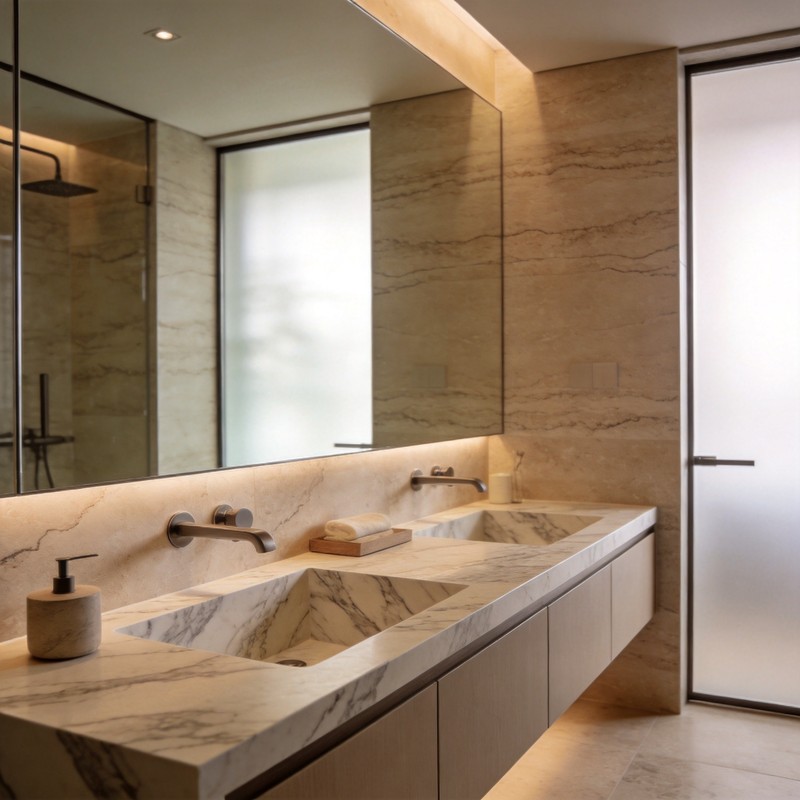
Transforming Bathroom Design with Sintered Stone
The bathroom has evolved from a purely functional space into a sanctuary of personal wellness—a room where material choices carry significant aesthetic and practical weight. Sintered stone bathroom design represents the intersection of cutting-edge material technology and sophisticated spatial thinking, offering architects and designers an unprecedented palette of possibilities.
For 2026, bathroom design trends emphasize continuous surfaces, seamless transitions, and the celebration of material authenticity. Sintered stone's unique combination of large-format capability, design versatility, and unmatched performance makes it the premier material for realizing these contemporary design ambitions.
1. Seamless Shower Enclosures
Traditional tile shower enclosures are defined by their grout lines—the constant horizontal and vertical interruptions that collect soap scum, mold, and mildew over time. Large format sintered stone panels eliminate this maintenance burden entirely. Two or three panels can cover an entire shower enclosure, creating a continuous, grout-free surface that wipes clean in seconds.
Marble-effect panels in Calacatta or Statuario finishes create shower enclosures that feel like carved stone chambers—luxurious, serene, and effortlessly maintained.
2. Waterfall Vanity Countertops
The waterfall edge treatment—where the countertop surface flows seamlessly over the cabinet edge to the floor—has become a defining gesture of contemporary bathroom design. Sintered stone's through-body color and pattern make it the ideal material for this application: the vertical waterfall surface presents the same visual character as the horizontal top, creating a genuinely designed element rather than a fabricated edge.
Paired with minimal vanity cabinetry, waterfall vanities in dark stone-effect or solid-color sintered stone create dramatic focal points in contemporary bathroom designs.
3. Full-Height Wall Cladding
Single sintered stone panels running from floor to ceiling create continuous wall surfaces that visually expand the bathroom space. The minimal joint lines—or complete absence of visible joints when panels are perfectly positioned—create an enveloping, immersive quality that tiles simply cannot achieve.
For smaller bathrooms, this technique is particularly effective: the continuous surface eliminates visual segmentation, making the space feel larger and more considered.
4. Marble-Effect Feature Walls
A single feature wall clad in marble-effect sintered stone creates a dramatic focal point that anchors the entire bathroom design. The dramatic veining patterns achievable in large format sintered stone slabs—running from floor to ceiling without interruption—create visual drama that would require significant budget and maintenance investment with natural marble.
The advantage of sintered stone over natural marble here is both practical (zero maintenance) and financial (significantly lower cost for equivalent visual impact).
5. Heated Floor Integration
Sintered stone flooring is fully compatible with underfloor heating systems. The material's thermal conductivity efficiently radiates heat from embedded heating elements, creating warm bathroom floors that enhance comfort during winter months. The thermal mass of thick sintered stone panels also helps regulate floor temperature, preventing the cold-floor discomfort associated with some flooring materials.
6. Floating Shelves and Storage
Ultra-thin sintered stone panels (3-6mm) enable the creation of floating shelves and built-in storage that combine structural integrity with visual lightness. These thin-format panels can be cut and machined using standard stone fabrication equipment, then mounted with concealed support systems to create floating shelves with no visible brackets.
The through-body color of sintered stone means that any cut edges—the shelf front and ends—present the same refined appearance as the surface.
7. Bathtub Surrounds
Freestanding bathtubs deserve surrounds that complement their sculptural quality. Sintered stone panels wrapping the platform or alcove surrounding a freestanding bathtub create a cohesive visual relationship between the tub and its environment. The material's warmth to the touch—even at ambient bathroom temperature—contrasts pleasantly with the reflective quality of the bathtub itself.
8. Contrasting Material Combinations
2026 bathroom design embraces bold material contrasts. Pairing sintered stone's refined, manufactured precision with organic materials—natural wood, living moss walls, woven textiles—creates layered spatial experiences that appeal to contemporary sensibilities. Dark, dramatic sintered stone surfaces contrast beautifully with warm natural wood tones and brass fixtures.
9. Integrated Drainage Channels
Some sintered stone designs incorporate precision-machined drainage channels that replace conventional linear drains. These integrated channels create invisible drainage solutions that maintain the visual integrity of the floor surface while ensuring effective water management. Particularly effective in curbless shower designs where the floor slopes gently toward an unobtrusive channel drain.
10. Textured Feature Panels
Beyond smooth polished or honed surfaces, textured sintered stone finishes—including groove, stone, and leather textures—create tactile feature panels that engage the sense of touch as well as sight. A textured feature wall behind a vanity creates visual depth and warmth that smooth surfaces cannot achieve.
11. Monochrome Material Schemes
For a sophisticated, hotel-inspired aesthetic, single-material monochrome schemes using sintered stone throughout the bathroom create spaces of unified visual calm. All walls, floors, vanity surfaces, and architectural details in matching white or light grey sintered stone create spaces that feel curated and luxurious without visual competition.
12. Book-Matched Veining Arrangements
Book-matching—installing adjacent marble-effect sintered stone slabs as mirror images of each other—creates dramatic symmetrical veining patterns across bathroom walls. The technique transforms a functional surface into an art installation, with the veining pattern appearing to flow outward from a central axis.
13. Bathroom Furniture and Vanities
Sintered stone's versatility extends to bathroom furniture. Thin-format panels (3-6mm) can be applied to cabinet door and drawer fronts, creating furniture with stone-finish surfaces that are lighter than solid stone but share the same aesthetic character. Combined with sintered stone countertops and wall panels, this approach creates total material coherence throughout the bathroom.
14. Black and Dramatic Palettes
Dark sintered stone surfaces—deep black, charcoal, and dark grey—have emerged as a leading trend for 2026 luxury bathrooms. These dramatic surfaces create intimate, moody atmospheres that feel genuinely spa-like. Combined with warm metallic fixtures in brushed bronze or aged brass, dark sintered stone bathrooms achieve a sophisticated warmth that white or light surfaces cannot.
15. Continuous Floor-to-Wall Transitions
The ultimate expression of sintered stone's large format capability is the continuous surface that wraps from floor to wall without interruption. Where conventional tile installation creates a visible horizontal joint at the floor-wall intersection, large format sintered stone panels can be selected and positioned to create a true continuous surface—architecturally dramatic and virtually maintenance-free.
Material Selection for Bathroom Applications
Finish Selection by Application
Different bathroom zones benefit from different surface treatments:
- Shower enclosures: Polished or honed finishes for easy cleaning; textured finishes only where slip resistance is prioritized
- Vanity countertops: Polished for glamour, honed or matte for practical maintenance resistance
- Bathroom floors: Textured or slip-resistant finish for safety; polished only in low-moisture areas
- Feature walls: Any finish depending on the desired aesthetic effect
Thickness Recommendations
For bathroom applications:
- Wall panels: 6-9mm for direct adhesion to prepared walls
- Vanity countertops: 12-15mm for standard residential; 20mm for commercial
- Flooring: 12mm for most applications; 15-20mm for heavy-use commercial bathrooms
- Furniture panels: 3-6mm for cabinet door and drawer fronts
Conclusion
Sintered stone bathroom design for 2026 is defined by the material's unique ability to unify aesthetic ambition with practical performance. From seamless shower enclosures to dramatic waterfall vanities, sintered stone enables design expressions that were previously impractical or impossibly expensive to maintain.
Ready to incorporate sintered stone into your bathroom design project? Contact MENGNA SURFACES for samples, design consultation, and technical specifications tailored to your project requirements.