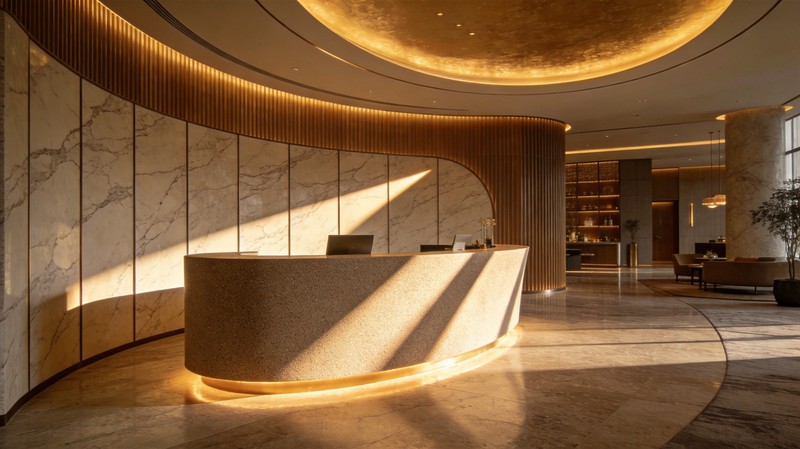
The architectural design landscape is evolving toward organic, flowing forms that break away from rigid straight lines. Sintered stone, already celebrated for its exceptional durability and aesthetic versatility, now offers designers an exciting possibility: thermobending technology that enables curved and bent applications without compromising material integrity.
Understanding Sintered Stone Thermobending Technology
Thermobending represents a significant advancement in stone processing technology. Unlike traditional stone materials that cannot be formed after firing, sintered stone's unique manufacturing process allows controlled reheating and reshaping under precise conditions. This capability opens unprecedented design possibilities while maintaining all the performance characteristics that make sintered stone ideal for demanding architectural applications.
The thermobending process works because sintered stone lacks the resin binders found in quartz surfaces. Instead, the material is held together through crystalline bonds formed during high-temperature sintering. When carefully reheated to specific temperatures, these bonds become temporarily more flexible, allowing the slab to be formed over curved molds. Upon cooling, the material re-crystallizes and returns to its characteristic hardness and durability.
The Science Behind Heat-Formed Stone
Sintered stone thermobending requires meticulous attention to temperature control, timing, and handling. The process typically involves several critical phases that together ensure successful formation without compromising material quality.
Phase 1: Controlled Heating
The slab enters a specialized oven where temperature increases gradually, typically reaching 150-200°C over 2-4 hours depending on thickness. This controlled heating ensures uniform temperature distribution throughout the slab, preventing thermal stress that could cause cracking. Modern thermobending facilities use computer-controlled ovens that monitor temperature at multiple points across the slab surface.
Phase 2: Forming
Once the target temperature is reached, the heated slab is transferred to a pre-prepared curved mold. Skilled technicians carefully position the slab, applying gradual pressure to achieve the desired curve. The mold itself is typically made from steel or composite materials, precisely engineered to produce the specific radius required for the project. This phase requires 15-30 minutes of careful manipulation.
Phase 3: Controlled Cooling
The formed piece remains on the mold while cooling slowly, typically over 4-8 hours. This gradual cooling allows the crystalline structure to reform evenly, maintaining the material's characteristic strength. Accelerated cooling can introduce stress points, so professional manufacturers maintain strict cooling protocols. Some facilities use insulated chambers to ensure truly gradual temperature reduction.
Minimum Bend Radius Guidelines
Understanding bend radius limitations is essential for project planning. The minimum achievable radius depends primarily on slab thickness, with thinner materials capable of tighter curves. However, thinner bent sections may have different structural characteristics than thicker applications, requiring careful engineering consideration.
| Slab Thickness | Minimum Bend Radius | Recommended Application |
|---|---|---|
| 3-4mm | 150mm | Curved wall panels, furniture components |
| 6mm | 300mm | Column wraps, curved counters |
| 12mm | 600mm | Bar tops, reception desks |
| 20mm | 1000mm | Structural curved elements |
Projects requiring multiple radii or compound curves may need special engineering consultation. Some manufacturers offer 3D modeling services that simulate stress distribution and predict potential issues before production begins.
Design Applications for Curved Sintered Stone
The architectural possibilities enabled by thermobending expand dramatically when designers understand the range of achievable forms. From subtle curves to dramatic flowing shapes, curved sintered stone can transform ordinary spaces into memorable environments.
Hospitality Venue Design
Hotels, restaurants, and entertainment venues increasingly embrace organic design languages that create distinctive atmospheres. Curved sintered stone reception desks flow seamlessly from front counter to back wall, eliminating visual joints while maintaining hygienic, easy-clean surfaces. Bar counters with gently curved fronts create welcoming silhouettes that invite interaction, while curved booth dividers provide acoustic benefits alongside visual appeal.
Retail Environment Applications
Luxury retail spaces utilize curved sintered stone to create aspirational environments that reinforce brand positioning. Circular display pedestals showcase products from all angles while their smooth curves complement premium merchandise. Curved window displays frame merchandise with architectural elegance, while rounded fitting room entrance frames soften the shopping experience.
Architectural Feature Elements
Column wraps transform structural necessities into design opportunities. Curved cladding can make columns disappear into flowing walls or, conversely, highlight them as sculptural elements. Curved staircases benefit from sintered stone's durability and slip resistance, while curved stair stringers and handrails create cohesive design narratives throughout vertical circulation spaces.
Furniture Design Integration
Custom furniture pieces leverage curved sintered stone to achieve forms impossible with conventional stone processing. Console tables with sweeping curves create dramatic entry statements. Coffee tables with gently curved tops and bases provide visual lightness while maintaining the material's characteristic durability. Dining tables with curved edges soften dining experiences while enabling efficient space utilization.
Technical Considerations for Thermobent Projects
Successful curved sintered stone installation requires attention to several technical factors that differ from standard flat panel applications. Understanding these considerations during the design phase prevents costly modifications during installation.
Structural Engineering
Curved panels may require different support systems than flat installations. While curved forms can provide inherent structural rigidity in some orientations, they may need additional backing or support in others. Projects should engage structural engineers familiar with curved stone installations to ensure appropriate specifications.
Expansion and Contraction
Temperature changes cause all stone materials to expand and contract slightly. Curved installations must accommodate this movement without inducing stress that could crack the material. Professional installers use flexible adhesives and strategic joint placement to allow controlled movement while maintaining visual continuity.
Edge Treatment
Edges of thermobent pieces require careful finishing. While straight edges can be machine-polished to consistent standards, curved edges often require hand finishing that maintains consistent appearance throughout the curve. This process is labor-intensive and should be factored into project timelines and budgets.
Seam Integration
Large curved installations typically require multiple panels joined together. Seams must be positioned to follow the curve naturally, minimizing visual disruption. Color-matched flexible sealants provide waterproof joints while allowing subtle movement. For extremely tight curves, manufacturers may produce single-piece elements to eliminate seams entirely.
Quality Control in Thermobending Production
Not all thermobent sintered stone achieves equal quality. Professional manufacturers implement multiple quality checkpoints throughout the production process to ensure consistent results. These checkpoints include visual inspection for surface defects after cooling, dimensional verification against specifications, and strength testing on sample pieces from each production batch.
Additionally, reputable manufacturers maintain detailed records of all production parameters, including heating curves, cooling times, and operator identification. This traceability enables quality issues to be identified and addressed quickly while providing documentation for project specifications.
Cost Considerations for Curved Applications
Thermobending adds significant cost compared to standard flat panel fabrication. The specialized equipment, extended production time, and skilled labor required command premium pricing. However, when evaluated against the alternative of multiple flat panels with complex cutouts and visible seams, curved applications may offer better value while achieving superior aesthetic results.
Project budgets should anticipate costs that typically run 3-5 times higher than equivalent flat panel installations. However, simplified installation requirements and reduced seam maintenance can partially offset premium fabrication costs over the project lifecycle.
Maintenance of Curved Sintered Stone Surfaces
One advantage of sintered stone, whether flat or curved, is minimal maintenance requirements. The non-porous surface resists staining and bacterial growth, while the hardness prevents scratching from daily use. Curved surfaces can be cleaned using the same methods as flat installations: regular wiping with mild detergent and soft cloth, followed by clean water rinse and drying.
However, curved surfaces present unique cleaning challenges. Irregular shapes may require additional attention to ensure thorough cleaning in concave areas. Professional cleaning services experienced with curved stone installations can address hard-to-reach areas while protecting the material's finish.
Working with MENGNA SURFACES for Thermobent Projects
MENGNA SURFACES offers comprehensive thermobending services for architects and designers seeking curved sintered stone solutions. Our facilities include state-of-the-art thermobending equipment capable of producing complex curved forms while maintaining strict quality control. Our technical team works closely with design professionals from concept through installation, ensuring optimal results for even the most ambitious curved stone applications.
We provide detailed consultation services that address material selection, radius optimization, structural requirements, and production planning. Our 3D visualization capabilities enable clients to preview curved installations before committing to production, reducing uncertainty and ensuring project success.
Ready to Explore Curved Design Possibilities?
Contact our technical team to discuss your thermobending project requirements. We provide detailed feasibility assessments, production quotes, and project timelines tailored to your specific design vision.
Request Thermobending Consultation