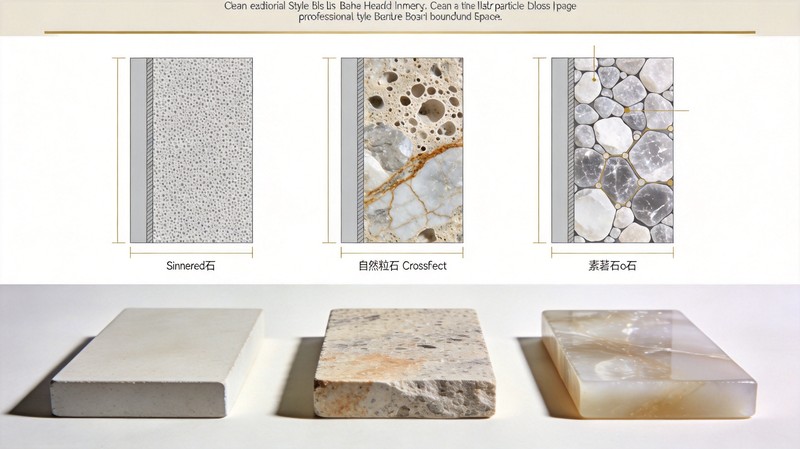
One of the most common questions architects and homeowners ask about sintered stone is whether it requires sealing. The definitive answer is no—sintered stone does not need to be sealed, ever. Understanding why requires a deeper look at the material's unique manufacturing process and physical properties that distinguish it fundamentally from natural stone and engineered quartz.
Understanding Stone Porosity and Sealing
Stone sealing exists to address one fundamental problem: porosity. When natural stone contains microscopic pores, capillaries, and voids, liquids can penetrate the surface, carrying pigments, oils, and bacteria deep into the material where they become permanent stains. Sealants fill these voids, creating a temporary barrier that prevents penetration.
The need for sealing is directly proportional to a stone's absorption rate. Materials with high absorption rates like sandstone and limestone require frequent sealing. Even dense natural stones like granite have measurable porosity that necessitates periodic sealant application. This ongoing maintenance requirement represents a significant cost and effort factor that architects must consider when specifying materials for commercial and residential projects.
Sintered stone eliminates this entire concern by virtue of its manufacturing process. The material's absorption rate of less than 0.02% places it firmly in the non-porous category, meaning there are simply no pathways for liquids to enter the surface. This is not a surface treatment or coating—it is an inherent material property that exists throughout the entire thickness of the slab.
Why Natural Stone Requires Sealing
To appreciate why sintered stone does not need sealing, it helps to understand why natural stone does. Natural stones form through geological processes spanning millions of years. Igneous stones like granite crystallize from magma, creating interlocking mineral grains with microscopic gaps between crystals. Metamorphic stones like marble recrystallize under heat and pressure, developing a different but equally porous structure. Sedimentary stones like limestone and travertine form from compressed sediment, leaving visible and microscopic voids.
These natural formation processes create inherent porosity that varies significantly between stone types. Granite typically has absorption rates between 0.2% and 0.5%, while marble ranges from 0.1% to 0.6%. More porous stones like limestone can exceed 2% absorption. Each percentage point represents significant staining vulnerability, driving the need for protective sealants.
| Material | Water Absorption Rate | Sealing Required |
|---|---|---|
| Sintered Stone | <0.02% | No |
| Granite | 0.2% - 0.5% | Yes, every 1-3 years |
| Marble | 0.1% - 0.6% | Yes, every 6-12 months |
| Quartz (Engineered) | 0.02% - 0.05% | Generally no, but resins degrade |
| Limestone | 1% - 3%+ | Yes, every 6 months |
| Travertine | 1% - 5%+ | Yes, every 6 months |
The Sintering Process: Creating Permanent Non-Porosity
Sintered stone achieves its non-porous nature through an extreme manufacturing process that bears no resemblance to natural stone formation. The process begins with carefully selected natural minerals—primarily quartz, feldspar, kaolin clay, and natural pigments—that are ground into an ultra-fine powder. These particles are then compressed under pressures exceeding 15,000 tons per square meter, far exceeding the compression found in natural geological processes.
After compression, the slabs enter kilns firing at temperatures above 1200°C. This extreme heat causes the mineral particles to undergo sintering—a process where particles fuse together at the molecular level without fully melting. The result is a completely dense, vitrified matrix with zero internal voids. Unlike natural stone's interlocking crystals with gaps between them, sintered stone's molecular structure is continuous and impermeable.
This process also explains why sintered stone's non-porosity is permanent. The sintered matrix is not a coating or treatment that can wear away—it exists throughout the entire slab. Even if the surface is scratched or chipped, the exposed material beneath remains just as non-porous as the original surface. Compare this to sealed natural stone, where damage to the sealant layer immediately exposes porous substrate vulnerable to staining.
Common Sealant Misconceptions
Misconception 1: All Stone Needs Sealing
The assumption that all stone surfaces require sealing stems from generations of experience with natural stone. While this was universally true for centuries, modern manufacturing processes have created materials that defy this convention. Sintered stone and high-quality porcelain are two examples of manufactured stone products that achieve permanent non-porosity through their production processes, rendering sealants unnecessary and potentially counterproductive.
Misconception 2: Sealant Provides Extra Protection
Some contractors apply sealant to sintered stone "just in case," assuming an extra layer of protection cannot hurt. In reality, applying sealant to a non-porous surface creates several problems. The sealant cannot penetrate the surface as intended, instead forming a thin film that can haze, yellow, or attract dirt. This film may create uneven sheen across the surface and can be difficult to remove without aggressive cleaning agents that might affect adjacent materials.
Misconception 3: Edges Need Sealing Even If the Surface Does Not
While cut edges may expose slightly different visual characteristics than the polished surface, the material composition remains identical. Sintered stone's non-porosity extends through the entire slab thickness, including edges. There is no structural reason to seal cut edges. However, some installers choose to polish edges to match the surface finish for aesthetic consistency, which is a visual decision rather than a protective requirement.
When Surface Treatments Might Be Considered
While traditional sealing is unnecessary, certain surface treatments may be applied to sintered stone in specific circumstances. Understanding these exceptions prevents confusion about the material's fundamental properties.
Grout Release Agents
During tile installation, grout can adhere to the surface, creating haze that requires vigorous cleaning. Some installers apply grout release agents—temporary coatings that prevent grout from bonding to the tile surface. These are not sealants and are removed after grouting is complete. They serve purely as installation aids rather than protective treatments.
Anti-Graffiti Treatments
In public installations where vandalism is a concern, anti-graffiti coatings may be applied to facilitate removal of paint, markers, and adhesives. While sintered stone itself resists these substances, cleaning graffiti from textured surfaces can be time-consuming. Anti-graffiti treatments create a sacrificial layer that allows faster cleanup, particularly important for municipal and transit applications.
Slip-Resistant Additives
For applications requiring enhanced slip resistance beyond the natural finish, transparent anti-slip treatments can be applied. These alter the surface coefficient of friction without affecting the stone's non-porous properties. Pool decks, commercial kitchens, and outdoor steps may benefit from these treatments where safety codes demand specific slip resistance ratings.
Cost Savings: Sealing vs. No Sealing
The absence of sealing requirements translates directly into cost savings over a project's lifecycle. These savings compound significantly in commercial installations with large surface areas.
Professional stone sealing typically costs between $3 and $7 per square foot per application, with most natural stones requiring resealing every 1-3 years. Over a 20-year commercial installation lifecycle, a 1,000-square-foot granite floor might require 7-10 sealing cycles, totaling $21,000 to $70,000 in maintenance costs. Sintered stone eliminates these costs entirely.
Beyond direct sealing costs, natural stone sealing also incurs indirect expenses: downtime during sealing and curing, potential damage from improper sealant application, and the risk of staining between sealant cycles when protection has worn thin. Sintered stone's permanent non-porosity eliminates all of these concerns.
How to Verify Sintered Stone Is Genuinely Non-Porous
For specifiers who want to confirm a product's non-porous claims, several simple tests provide reliable verification.
The Water Drop Test
Place a few drops of water on the stone surface and leave them for 30 minutes. On porous stone, water absorbs into the surface, darkening the material. On sintered stone, the water drops remain on the surface and can be wiped away without leaving any mark or discoloration.
The Lemon Juice Test
Apply lemon juice to the surface and leave for 15 minutes. Acidic liquids etch and discolor marble and limestone. Sintered stone, which is chemically inert, shows no reaction whatsoever. The juice can be wiped away leaving the surface in perfect condition.
The Ink Test
Apply a permanent marker to the surface and allow it to dry for several hours. On porous stone, ink penetrates deeply and cannot be fully removed. On sintered stone, the ink sits on the surface and can be removed completely with standard household cleaning products or rubbing alcohol.
Sintered Stone vs. Quartz: A Sealing Comparison
While sintered stone and quartz are both manufactured products, their sealing requirements differ significantly. Engineered quartz contains approximately 7-10% resin binders that provide some porosity protection. However, these resins can degrade over time when exposed to UV light, heat, and harsh chemicals, potentially increasing surface porosity in aged installations.
Sintered stone contains zero resin binders, relying entirely on sintered mineral bonds that are chemically identical to natural mineral formations. This composition means sintered stone's non-porosity cannot degrade, unlike quartz where resin aging may eventually compromise surface integrity. For projects with long lifecycle requirements, this distinction becomes particularly important.
Additionally, quartz surfaces can be damaged by high heat that melts resin binders, potentially creating localized porous areas. Sintered stone withstands temperatures exceeding 1200°C without any change to its structural properties, making it fundamentally more resistant to thermal damage that could compromise surface integrity.
Specifying Sintered Stone for Stain-Sensitive Applications
Understanding that sintered stone never requires sealing makes it particularly valuable for applications where staining is a primary concern. Commercial kitchens, laboratory surfaces, healthcare facilities, and food preparation areas all benefit from the material's permanent stain resistance.
In restaurant table top applications, where wine, sauces, and oils are daily hazards, sintered stone's non-porosity ensures surfaces remain pristine without any maintenance intervention. Similarly, bathroom vanity tops exposed to cosmetics, hair dyes, and personal care products maintain their appearance indefinitely.
For healthcare environments, the combination of non-porosity and hygienic surface properties meets stringent infection control requirements without the ongoing maintenance burden that sealed natural stone presents. This is especially critical in sterile environments where sealant degradation could compromise hygiene standards.
Maintenance Best Practices for Non-Sealed Sintered Stone
While sintered stone requires no sealing, proper maintenance ensures the surface maintains its appearance for decades. Daily cleaning with mild detergent and warm water is sufficient for most situations. For tougher residues, non-abrasive cleaners can be used without concern for damaging a sealant layer—because there is none.
Avoid using abrasive pads, steel wool, or harsh chemical cleaners containing hydrofluoric acid, as these can physically damage the surface finish even though they cannot penetrate it. The complete maintenance guide provides detailed care instructions for all finish types.
Need Clarification on Sintered Stone Properties?
Our technical team can provide detailed material specifications, absorption rate certificates, and application guidance for your project. Contact us for expert consultation on specifying sintered stone.
Request Technical Specifications